Internship Report
During my intership in INSERM Unit S1134, Macromolecular Biology, my supervisors Yassine Ghouzam and Jean-Christophe Gelly explained to me the structure of a master internship report. Here is the structure to follow and what to include in each section.
Plan
1. Summary
If they are more than 5 pages, you have to write a summary. It must be short; half a page maximum. It includes:
- Scientific context of the study
- Main results
- Relevant conclusions
2. Introduction
Detailled presentation of the scientific context i.e. previous published works done about the scientific question. It put the emphasis on the originality of your work and your main objectives. It also includes the annoucement of the plan of the report.
3. Materials & Methods
This is the most thorough part of the report and show to the reader how to reproduce your work.
- Sources of data
- Methods for processing data
- Methods for the analysis
- Softwares and dependencies (always introduced with the implemented method)
- Bibliography references
4. Results
The results produced by the methods described in Materials & Methods section. Their order of presentation must be logicial (not necessary chronological).
- Objectives and purpose
- Used method described in the Materials & Methods section
- Resulting tables, values and figures
- Commentaries about tables, values and figures
5. Discussion & Conclusion
- List of all conclusions of each result (1-2 sentences per result).
- Where each result is in the scientific context presented in the introduction
- Open about suggestion of the next analysis that will be required to go further after this study
6. References
List of all the bibliography references (scientific articles, books, websites, etc.) quoted in the report. References are numbered by order of appearance within the text: [1], [2], [3], etc. In the References section, they are listed by their number. Each reference must show:
- Number
- List of all Authors
- Title
- Journal
- Volume number
- Page number
- Publishing year
- DOI (Digital Object Identifier) unique link
publisher_id/article_idto access article online - ISBN-13 (International Standard Book Number) unique 13-digit number to identify book online
Example of scientific article reference:
[1] ORION : a web server for protein fold recognition and structure prediction using evolutionary hybrid profiles
Yassine Ghouzam, Guillaume Postic, Pierre-Edouard Guerin, Alexandre G. de Brevern & Jean-Christophe Gelly
Scientific Reports6, Article number: 28268 (2016) DOI: 10.1038/srep28268
Example of book reference:
[2] Learning the bash Shell: Unix Shell Programming
Cameron Newham and Bill Rosenblatt
O'Reilly Media, 1995. ISBN‑13: 978-0596009656
Content
Figures
Any figure in the document must be completed with:
- Figure number (1, 2A, 2B, 3, etc.) by order of appearance within the text
- Title
- Legend
If the figure is a set or a grid of figures, then you must name each figure within the figure as (A), (B), (C), etc.
The resolution must be high enough so the text can be visible. The used palette must be colorblind-safe. Always label axes with units. Do not use abbreviations.
Example:
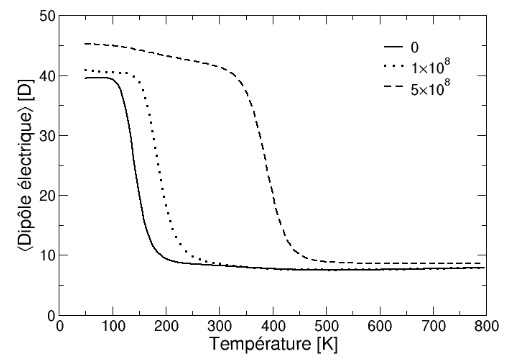
Figure 1: Variations of the mean electric dipole moment of the Ala12 peptide as a function of temperature. Different electric field strenghts are shown: 0 V/m (solid line), 1x 10^8 V/m (dashed line), and 5 x 10^8 V/m (dotted line)
Tables
Any table in the document must be completed with:
- Figure number (1, 2A, 2B, 3, etc.) by order of appearance within the text
- Title
- Legend
Practical Advices
- Start with the figures, the tables and the results
- Describe the methods that produced the results. You do not need to have a nice style for this part as it is technical.
- Introduction and discussion should be written together as it is about scientific context and you need to put your results within this perspective only.
- Never use expressions such as
here it is,This is obviouslyorOne can sayorIn my opinion. - Write your report in two or three sessions. Submit it for review.
Layout
Cover page
The cover page is the first visible page of the report. It is therefore essential to include the following information:
- Surname, first name, and student ID number
- Program/degree track
- Course title and code
- Report title (short but sufficiently descriptive)
- University and date
It is also good practice to include the logo of your university, as well as, where applicable, the logos of institutes or organisations funding or hosting you i.e. providing you with a workspace and a bench.
Format
Footers should include the report writing date, page number, and total number of pages.
The header may be used to repeat the report title.
For a written report, a serif font e.g. Times New Roman should be used, as these are more readable. Serifs act as guides for the eye, improving reading flow. Sans-serif fonts e.g. Arial, Helvetica should be reserved for posters and presentation slides.
A font size of 12 pt is a minimum (slightly smaller may be acceptable for the bibliography). Line spacing of 1.5 is recommended to allow room for annotations.
Margins should be sufficiently wide (1.5 to 2 cm) to leave space for notes and to improve page layout.
Sections and subsections should be numbered. A table of contents placed immediately after the cover page is strongly recommended, as it provides a quick overview of the structure and helps locate specific sections.
References
- Advices to write a scientific report: Gaelle Lelandais et Pierre Poulain
Relevant Tags
About the Author

Latest Articles
-
Research Tax Credit
The Research Activities Tax Credit is a tax credit that incentivizes private companies to increase their Research and Development (R&D). Within my company, I have been tasked with writing the Research Tax Credit (CIR) justification report for France. Here, the method for writing such a report.OCT 2025 · PIERRE-EDOUARD GUERIN -
Turing Complete: From Logical Gates to CPU Architecture
In 2021, LevelHead published Turing Complete, a game about computer science. My friend Christophe Georgescu recommended me to play it. Unfortunately, I took his advice and now I can not stop to play this game! The game challenges you to design an entire computer from scratch. You start with basic logic gates, then move on to components, memory, CPU architecture, and finally assembly programming. By the way, the game is neat and present all these concepts in a playful and intuitive way.SEP 2025 · PIERRE-EDOUARD GUERIN -
How to Manage a Project?
In any company, every task is part of a project. I am responsible for managing multiple projects each year. I have to present deliverables to stakeholders, meet deadlines, allocate mandays and coordinate everyone’s actions. This is a meticulous work that requires a strong methodology.JUN 2025 · PIERRE-EDOUARD GUERIN